
||| Rally in Raleigh for North Carolina Wage Board (October 7th, 2015): The Fight for $15 convened a forum at the state legislature to take testimony from workers and supporters and to call for the creation of a “People’s Wage Board” to advocate for raising wages in North Carolina. ||| Durham Joins Fight for $15 Global Day of Protest (April 14th, 2016): As part of a global day of protest against poor wages and working conditions, fast food employees and other underpaid workers strike in Durham for a $15 minimum wage and a union. A morning picket line is formed at McDonald's at 102 East Morgan St., followed by a panel discussion at NCCU's Criminal Justice Building and a larger rally with workers from across the state. ||| Durham Workers Join Nationwide Labor Day Protests by Walking Out of Their Jobs (September 4th, 2017): At 6 a.m., dozens of Durham workers walked out of their jobs as part of a nationwide protest to raise the national minimum wage to $15 an hour. Cooks and cashiers from the local McDonald's, Burger Kings and other restaurants joined employees in 300 other cities as part of the nationwide protest. Later in the afternoon, the Durham strikers moved to CCB plaza. Some dietary aides, nurse assistants, and other employees at hospitals also joined the protest. ||| ||| Greenville Fast Food Workers Commemorate Memphis Sanitation Strike by Protesting for Better Pay (February 12th, 2018): Individuals affiliated with the Fight for 15 and the Poor People's Campaign gather to rally outside the McDonald's on Memorial Drive and Stantonsburg Road. More than a dozen fast food workers protested for a higher minimum wage and workplace equality. The event is held on the 50th anniversary of the Memphis Sanitation Strike in 1968, when a group of African American men gathered to demand a raise in wages to $2 an hour. ||| North Carolina Workers Commemorate MLK's Assassination by Demanding a Living Wage (April 4th, 2018): On the anniversary of King’s assassination, city workers, community-labor support groups, and faith organizations in Winston-Salem, N.C., hold a rally for a living wage of at least $15 an hour. Over 100 people gathered at the event.
The Fight for $15 utilizes social media to highlight a range of issues relevant to the group's cause, from the racial wealth gap to exploding CEO pay. By sharing a wide-range of articles, the group contextualizes the oppression faced by fast-food workers within a greater web of oppression. These communications emphasize the intersectionality that is needed to advance the movement; it is not just about raising the wages for fast-food workers, but rather dismantling the multifaceted systems that ensnare society's most vulnerable.
The Fight for $15 highlights their various achievements and victories on the "Press Room" page of their website, allowing visitors to see the large impact the movement has had in such a short time all in one place.
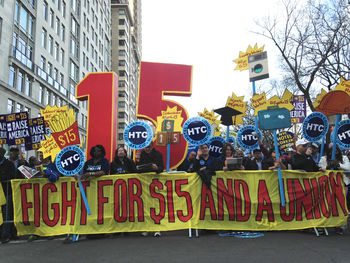
In addition, Fight for $15's protests and strikes have largely taken place in metropolitan areas that are brimming with fast food chains and other retail establishments. By walking off the job and flooding busy city streets around the globe, the workers are making themselves visible to the many residents that rely on their labor but try to keep the laborers themselves out of sight and out of mind. Their signs often represent subversions of fast food companies' logos, attempting to associate these well-known brands with exploitation rather than food. The Fight for $15 is not just about reaching corporate executives and government officials-- it has the more ambitious goal of shifting the dominant logics surrounding low-wage workers in the United States and other advanced capitalist economies. Entrenched stereotypes about low-wage workers will not die any time soon, but, thus far, the Fight for $15 has been very successful far shifting the conversation away from individualistic moralizing towards a focus on structural forces.
In terms of bringing more workers into the fold, the Fight for $15's website has a "For Workers" tab that features steps on how to join the Fight for $15 and how to go on strike. This also includes a "strike letter" that workers can fill out and deliver to their boss to notify them of a strike. The page also has tips on how to go about striking in the most potent way possible.
The Fight for 15 also works with a variety of local unions in order amplify each other's messages. For example, the Fight for $15 has coordinated with the Duke Faulty Union (DFU) for the past several years. Both are affiliated with the SEIU and use the same union offices, thus making it easy for DFU to stay informed of the Fight for 15's activities, and vice versa. DFU helps spread the word about Fight for $15 events and programs through email and social media, as well as participating in their rallies, marches, and demonstrations. DFU members even speak at Fight for $15 events. In turn, the Fight for $15 does the same for DFU, which often uses Fight for 15 speakers at their events. Across the globe, the Fight has fostered similar relationships with local organizations and movements that have proved to be immensely valuable for both sides.
The major goal of the Fight for $15 to bring together the balkanized American low-wage labor force for the purpose of organizing and unionizing. Before the start of Fight for $15, unionization in fast food restaurants and similar occupations was unheard of, as the vulnerable workers could not take the risk of getting fired (a common outcome when low-wage workers organize in any fashion). Thus, a challenging but worthwhile task for the Fight for $15 is opening up spaces for low-wage workers to voice their sentiments and demands without fear of being fired. While it will certainly take a while, this goal is integral for bringing back formidable organized labor in the United States. These new spaces for low-wage workers are integral to combating the atomization of the minimum wage labor force, which greatly aids corporations in isolating workers and keeping wages down. Fight for $15 has helped make low-wage workers feel less alone and more empowered, which is admirable considering the disrespect for fast-food and other low-wage workers that has been continually perpetuated in the U.S. Rather than just demanding slight wage increases, the Fight for $15 demands that low-wage workers be given respect and treated as the vital part of the modern economy that they are.
The Use of Multiple Languages to Highlight the Intersectional and Global Nature of the Fight


The Use of Posters to Subvert Corporations' Brands


