

Science has historically always come under fire when its evidence-supported ideas have contradicted social norms--Copernicus was attacked for his heliocentric model of the universe, Darwin was disregarded because of his theory of evolution by natural selection, and presently climate change has come under fire as a "hoax." Contemporary politics that have questioned the validity of science is not a new development but rather a continuation of centuries of history. The March for Science intends to change this dynamic of science and society, establishing science's place as an informant of all aspects of civilization. Science (from the stringent efforts of the scientific method to establish reproducible and valid data) should be implemented rather than first debated if it is true or not by uninformed parties.

Furthermore, the hijacking of science for the gain of political parties has always existed with politicians selectively highlighting the data they want in order to further their own agendas. This has to end. Science should be utilized holistically and in pursuit of the truth for the betterment of all society--not for the one or the few--and so it must be de-politicized.
http://annals.org.proxy.lib.duke.edu/aim/fullarticle/2620158/alternative...
The above political cartoon was drawn by Adam Zyglis and demonstrates the continual denial of scientific fact by sectors of the public throughout history. Science has perpetually faced opposition when first postulated. https://www.pinterest.com/pin/273593746089616455
Originally conceived on January 24th, 2017 (four days after the inauguration of President Donald Trump), the first March for Science was held on Earth Day (April 22nd) 2017. The movement began as a rebuttal to the Trump Administration's proposed budget that consisted of significant cuts to scientific research in departments like the NIH and EPA as well as actions taken to suspend ongoing research in subjects like fossil fuels and climate change. Furthermore, the continual dismissal of truth and the propagation of "fake news" throughout the 2016 American Presidential Election by certain candidates gave credence to why the March for Science and its support of evidence and truth-finding needed to happen.
Entering into its second year, the March for Science continues to expand and hopes to reach even more members in societies all around the world, paving the way for increased empiricism and accuracy in the modern age. The March for Science is just getting started...
http://annals.org.proxy.lib.duke.edu/aim/fullarticle/2620159/march-science
http://annals.org.proxy.lib.duke.edu/aim/fullarticle/2620158/alternative...
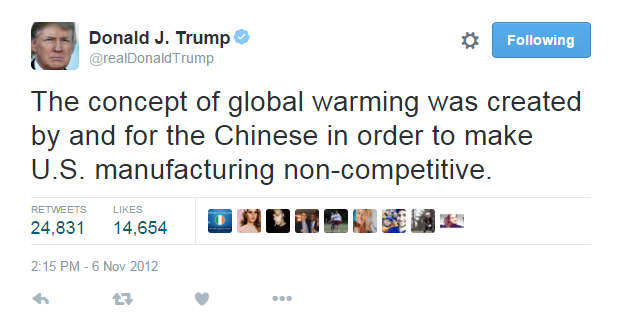
The above photo is a screenshot of a tweet by President Trump in 2012 (four years before his presidential campaign) that clearly outlines his stance on climate change. http://www.politifact.com/truth-o-meter/statements/2016/jun/03/hillary-c...
The March for Science embodies several key ideologies like feminism and egalitarianism and anti-racism. In order to incorporate as many members of society in support of science, the movement seeks to support women in STEM as well as representation and involvement of people from all walks of life equally in science. While these ideologies are central to the March for Science and its directives, they have by no means been fully realized yet as representation in science careers is still lopsided; the movement hopes that their efforts will correct this misrepresentation for future generations, making science open for all people completely and equally.
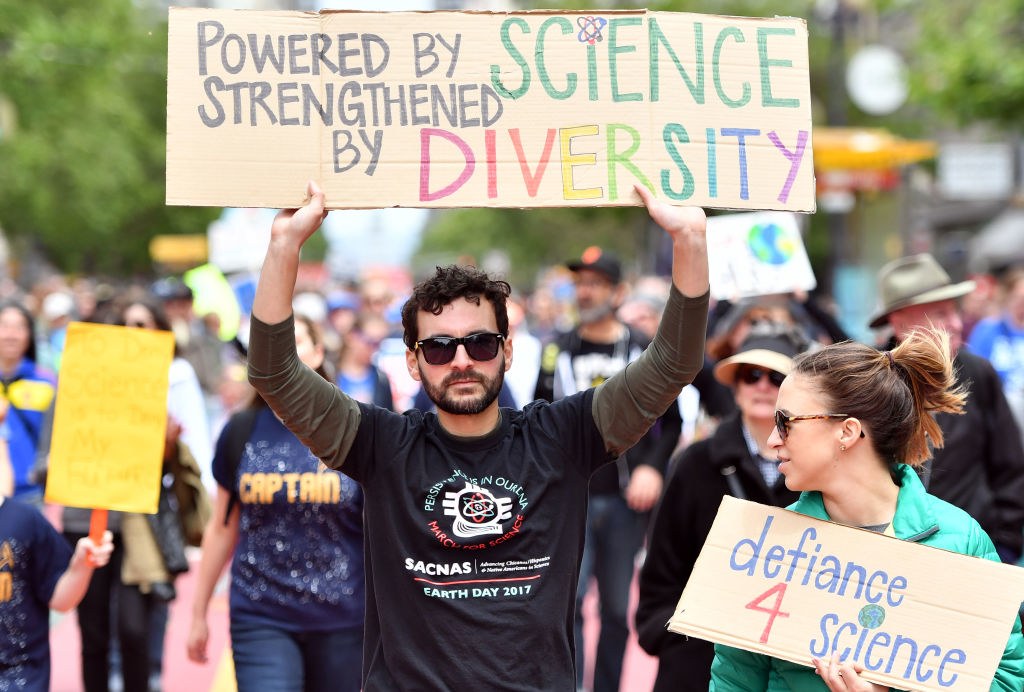
This is a photo of Raul Tores at the San Francisco March for Science; Tores is a member of Advancing Chicano/Hispanic & Native Americans in science (SACNAS). His sign emphasizes the need for diversity in science as well as representation in scientific bodies. https://diversity.ucsf.edu/community/sci-march
In order for this movement to be as bottom-up as possible, the March for Science heavily emphasizes organization at the local level. An higher "overall" March for Science panel exists in order to standardize the movement's goals and direction, but each march in cities around the world is able to organize when, where, and how they see fit within the model of the movement.
The March for Science features several staff members overseen by a board with both constituted heavily by women scientists (a part of the movement's initiative to give underrepresented populations a voice in the sciences). Furthermore, many of the board and staff members represent minority peoples of color, making the March for Science and multi-faceted representation of as many parts of society as possible.
.jpg "Science-March (1).jpg")
In regards to the marchers themselves, a cross-section of the scientific community is involved. From older and younger scientists alike, many people feel inspired to be engaged in the March for Science as the climate of their respective fields comes under pressure from governments and societies around the world. That being said, while the scientists represented is a cross-section of scientists, that does not necessarily mean they are a microcosm of society as a whole; gender and person-of-color disparities across scientific disciplines still prevail and is one of the hot-button topics the March for Science hopes to address.
https://www.marchforscience.com/who-we-are
This photo of science personality Bill Nye was taken by Bill O'Leary at the front of the D.C. March for Science procession. Nye has been a longtime supporter of science education. https://www.newyorker.com/tech/elements/the-usefulness-of-a-march-for-sc...